- TaxStache
- Posts
- 1/13/26 Newsletter
1/13/26 Newsletter
In partnership with

The holiday decorations are down, the confetti is swept, and just as you settle back into reality, the IRS is here with a friendly reminder that last year’s Q4 estimated tax payment is due in exactly 48 hours.
This week’s lineup:
💰 Higher tax rates only apply to extra earnings, so you never lose money by getting a raise.
🧮 Math error notices aren't audits, but you only have 60 days to dispute them.
💼 A bad W-4 means giving the government an interest-free loan all year.
🍷 “Real Housewives” stars flashed cash while pleading poverty, swapping fame for federal prison.
Money Moves
💰 The Truth About Tax Brackets in 2025

Image from Unsplash
The Quick & Bristly: Tax brackets don’t work the way many people think. Moving into a higher bracket never taxes all your income at the higher rate, only the dollars above the cutoff. Thanks to inflation adjustments in 2026, brackets are wider than ever, and earning more always leaves you with more money. A raise can’t make you poorer, so take it.
Everyone knows the “Water Cooler Economist.” He’s the guy who refuses overtime because he’s convinced an extra thousand dollars will shove him into a higher tax bracket, trigger an IRS ambush, and somehow make him poorer. It’s one of the most expensive myths in America.
For 2026, there’s no secret new tax law driving the bracket changes. It’s simply inflation doing what inflation does. But the core rule is unchanged: earning more money always leaves you with more money.
The Bucket Theory: How Your Income Actually Gets Taxed
You don’t have one tax rate. You have several, and your income flows through them like a series of buckets.
Bucket #1: The “Free” Bucket (Standard Deduction)
Before the IRS taxes a single dollar you earn, you get a massive deduction:
Single: $15,000
Married Filing Jointly: $30,000
A married couple earning $30,000 pays roughly zero in federal income tax.
Bucket #2: The 10 Percent Bucket
After the Standard Deduction, the first $11,925 of taxable income (single) is taxed at just 10 percent.
Bucket #3: The 12 Percent Bucket
The next chunk of income, up to $48,475 for single filers, is taxed at 12 percent.
Bucket #4: The “Scary” Bucket (22 Percent)
This is where the myths start. If you earn more than $48,475 (single), you enter the 22 percent bracket. Only the dollars above that line get taxed at 22 percent.
All your earlier income still enjoys the 0 percent, 10 percent, and 12 percent rates. You’re not losing money. You’re paying a slightly higher rate only on the new money you made.
Does that mean all your money is suddenly taxed at 22 percent? (Spoiler: No). Click to see how the math really works and why you should never turn down a raise. Keep reading →
PRESENTED BY FINANCE BUZZ
You could be wasting hundreds on car insurance

You could be wasting hundreds every year on overpriced insurance. The experts at FinanceBuzz believe they can help. If your rate went up in the last 12 months, check out this new tool from FinanceBuzz to see if you’re overpaying in just a few clicks! They match drivers with companies reporting savings of $600 or more per year when switching!* Plus, once you use it, you’ll always have access to the lowest rates; best yet, it’s free. Answer a few easy questions to see how much you could be saving.
Can a parent deduct the cost of their child's clarinet lessons as a medical expense?
(Find the answer at the end of this newsletter)
IRS Survival Guide
🧮 Guide to IRS Math Errors

Photo from Unsplash
The Quick & Bristly: Most “math error” notices aren’t audits. They’re quick corrections the IRS makes when something on your return doesn’t match their records. The letter starts a strict 60-day clock, and that deadline controls your right to fight the change. Read it fast, compare the numbers, and if you disagree, request an abatement before the deadline so you keep your right to challenge the IRS without paying first.
Opening your mailbox and seeing “Internal Revenue Service” on the envelope is an instant stress spike. Heart races, stomach drops, brain goes straight to one word: audit.
But for the 2026 tax season, if you get a notice, odds are you are not being audited. In many cases, you are looking at a Math Error Notice, one of millions of automated letters the IRS sends every year when its computer system spots a discrepancy on your return.
These notices are usually less serious than an audit, but they are not harmless. They are what the IRS calls a summary assessment, which means your bill can change fast, and your rights to fight that change expire on a strict timeline.
This guide walks you through what those notices mean, how to read them, and what to do next.
What the IRS Really Means by a “Math Error”
When most of us hear “math error,” we think of a simple mistake. You added $200 and $300 and somehow got $600. Those mistakes count, but the IRS definition is much broader.
Under what is known as Math Error Authority (MEA), Congress lets the IRS correct certain “clerical” or obvious mistakes without going through a full audit. Common triggers include:
Arithmetic mistakes: Basic addition, subtraction, or multiplication errors on the return.
Data mismatches: A Social Security number or name for you or a dependent does not match what the Social Security Administration has on file.
Missing information: You claimed a credit, such as the Earned Income Tax Credit (EITC), but did not include a required form or schedule.
Exceeding legal limits: You claimed more of a credit or deduction than the law allows for your income or filing situation.
In short, if the IRS computer can clearly tell that an entry is wrong or incomplete based on what it already knows, it may “fix” your return on its own and then send you a notice showing the change. Sometimes that means a smaller refund, sometimes a bigger one, and sometimes a new balance due.
CP11, CP12, CP13: How To Decode Your Notice
To figure out exactly what changed, look in the top right corner of your letter. You will usually see one of these codes:
CP11: The IRS found an error, corrected it, and now you owe money. Sometimes this means your refund was reduced so much that you now have a balance due.
CP12: The IRS found an error, corrected it, and your refund amount changed. You may still be getting money back, just a different amount than you expected.
CP13: The IRS found an error, corrected it, and the result is a zero balance. No money owed, no refund coming.
Inside the notice, you should see a side-by-side breakdown, usually labeled something like:
“Figures from your return”
“Figures we used”
That table is your roadmap. It shows exactly where the IRS changed your numbers.
Discover the new 2026 law that forces the IRS to explain their math — and the one deadline that kills your chance to fight back. Keep reading →
Pick Your Monthly Tax Treat
We’re testing something new. Once a month, we’ll send out a short, made-just-for-you email based on what you actually care about. Small business tips. Gig-worker headaches. Retiree riddles. Real-estate chaos. All the fun stuff.
Each one comes with useful tips and tiny tax wins to help you with what you need the most. And our favorite part? A downloadable cheat sheet every month that you can actually use, instead of pretending you’ll read later.
If you want in, you can just tap the poll below and tell us your lane. We’ll do the rest.
Which group do you identify most with? |
PS: If more than one of these applies to you, reply to this email with your choices, and we’ll make sure you’re on all the lists you want!
Filling 101
💼 New Job? Don't Mess Up the W-4
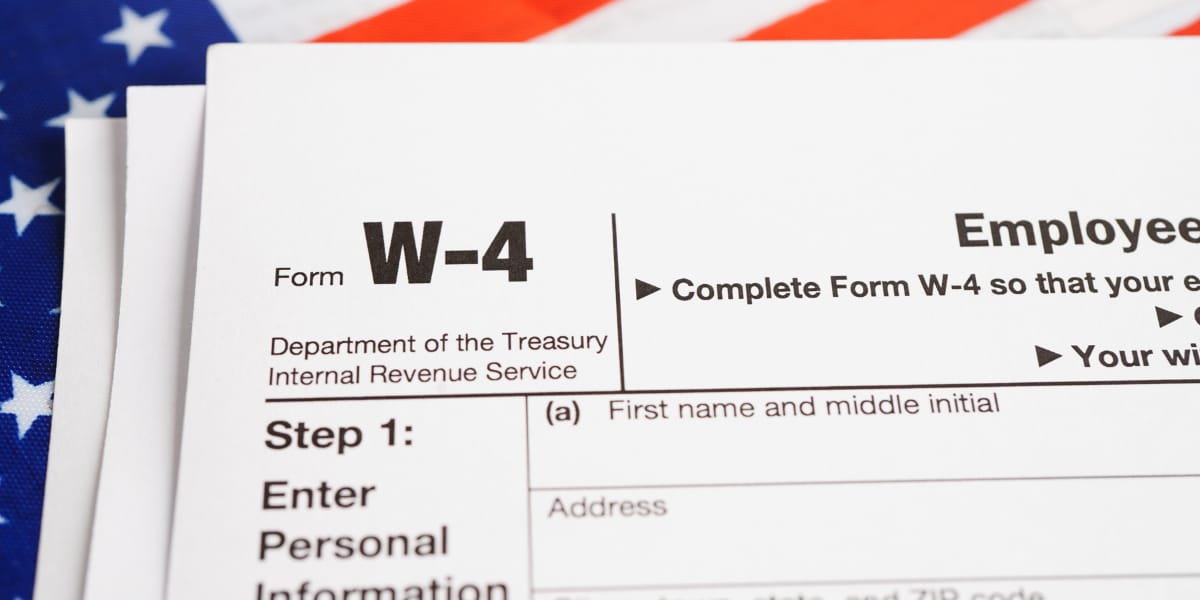
Photo from Unsplash
The Quick & Bristly: Your W-4 determines your paycheck withholding, and filling it out incorrectly means either a surprise tax bill or giving the government an interest-free loan. Also, watch out for signing bonuses: they are often taxed at a flat 22%, meaning high earners will still owe the difference come April.
Ah, the new job. It’s a beautiful thing. A fresh start, a bigger salary, maybe even an office with a window that doesn’t look directly at a brick wall. You’ve navigated the awkward interviews, negotiated your salary like a pro, and now you’re ready to conquer the world.
But amid the flurry of orientation meetings and learning where they hide the good coffee, you’ll be handed a stack of paperwork. And nestled within it, like a viper in a bouquet of roses, is the infamous Form W-4.
Your New Job and the W-4: What You Need to Know
Form W-4, officially the "Employee's Withholding Certificate," is the form you use to tell your new employer how much federal income tax to lovingly carve out of your paycheck. For such a small form, it packs a mighty punch. Fill it out wrong, and you could be in for a nasty surprise come Tax Day.
Years ago, it was all about "allowances," a mysterious number you sort of guessed at based on how many cats you owned. The new W-4 is a bit more direct. It wants to know about your dependents, your spouse's income, and any other jobs you might have. It’s less of a guessing game and more of a "please, just tell us what's going on so we don't have to send you a bill later."
The Withholding Puzzle: Not Too Little, Not Too Much
The goal with your W-4 is to get your withholding just right.
If you withhold too little, you'll owe a big chunk of money to the IRS in April, possibly with a side of underpayment penalties. It’s like eating dessert all year and then having to eat nothing but broccoli for a month.
If you withhold too much, you’re essentially giving the government an interest-free loan with your money. Sure, getting a big refund feels nice, but it’s your money to begin with. You could have been using it all year for important things, like buying more of that good coffee.
Remember to revisit your W-4 whenever you have a major life change, like getting married, having a baby, or if your spouse lands a new gig, too.
Learn why your signing bonus might trigger a surprise tax bill and which "free" company perks the IRS actually considers taxable income. Keep reading →
ALSO PRESENTED BY CBDISTILLERY
Support Your New Years Resolutions with CBD

Setting a New Years resolution is a lot easier than keeping it. But CBDistillery’s expertly-formulated CBD products make sticking with your resolutions easier. Save 25% on CBD to ease pain after workouts, stress less, sleep better or unwind alcohol-free with code HNY25 and keep your resolutions on track.
Wild Tax Tales
🍷 Table Flips & Tax Fraud: The Giudice Saga

Image by Andres M.
The Quick & Bristly: Teresa and Joe Giudice turned “The Real Housewives of New Jersey” into a federal indictment by flashing cash on TV while pleading poverty to the government. Result: Prison sentences for both, deportation for Joe, and a lingering $3 million tax bill that proves old habits die hard.
There is a specific kind of audacity required to go on national television, flip a table in a rage, and pay for furniture with wads of cash while simultaneously telling the U.S. government you are destitute. Most people commit tax fraud in the dark; Teresa and Joe Giudice did it in Bravo high-definition.
The “Real Housewives” stars didn’t just make a math error. They treated the federal tax code like a suggestion box. Here is how they went from reality royalty to federal inmates.
The "Oopsie" Bankruptcy
In 2009, the couple filed for bankruptcy, claiming they were drowning in debt. The problem? The bankruptcy trustee had a TV. He noticed they were hiding assets, rental income, and a massive reality TV salary while claiming to be broke. Lying to a bankruptcy court is a federal crime, and by filing, they essentially invited the feds to audit their entire existence.
The Laundry List
The indictment was a "greatest hits" of financial crimes. The Giudices used fake W-2s to get $5 million in mortgages they couldn’t afford. Joe failed to file tax returns for years despite earning millions. In 2014, they pleaded guilty to 41 counts of fraud.
The Aftermath
Teresa served 11 months in federal prison; Joe served 41 months. Because Joe never became a U.S. citizen despite living there since he was a toddler, he was deported to Italy immediately after his release.
And the drama isn’t over. As of 2024, Teresa is reportedly facing over $3 million in new tax liens. It seems the lifestyle of the rich and famous is expensive — especially when you forget to pay Uncle Sam.

The quick (and slightly prickly) stories we didn’t have time to get to:
🏛️ Congress targets crypto rules and tax extenders for 2026 agenda.
💸 Inflation adjustments in 2026 could slightly increase your paycheck.
🚗 New deduction allows write-offs for U.S.-made car loan interest.
If you made it this far, you’re our kind of nerd. Hit reply and tell us which story you want us to dive deeper into next week.
Share the ‘Stache

For a limited time… if you share TaxStache with ONE FRIEND using the link below, you’ll receive a special Tax Season Prep Checklist curated by our super savvy tax-smart team absolutely free.
If you liked the newsletter, send it along to someone and get ahead of the IRS this year.
Your Referral Count is 0. If you have already referred friends to our newsletter and refer someone new, reply to this email and let us know, and we’ll email you the list.
Or copy your personal referral link and share it with friends:
https://taxstache.beehiiv.com/subscribe?ref=PLACEHOLDER
Answer: 🎺 Believe it or not, yes!
In a 1962 ruling, the IRS allowed a parent to deduct the cost of a clarinet and lessons because an orthodontist specifically recommended them to help correct the child’s overbite. But don’t try this with piano lessons — unless you can prove playing scales fixes a cavity.
How's the Stache doing this week? |